Thursday, 16 January 2014

PosTextiles

PosTextiles are an art collective who have all graduated from the Texile Futures MA at Central Saint Martins. Their work is concept driven using future technologies that aren't yet at reality but with the idea tthat they one day could be. I love this style of working. It's so imaginative and really makes you think about what the future could hold. Amy Cogden's work visualises a time when we will grow our own jewellery from skin cells. Cells are another kind of structure.
Natsai Audrey Chieza
Ann-Kristin Abel
Amy Congden

Body Adornment/Distortion

The live brief I have chosen is to create a piece of jewellery for Urban Outfittters. I looked at distortion in unit x last year and I wanted draw on those ideas for this brief. I want to explore jewellery as a form of structure added to the body so that it ties in with my personal project. The following artists have adorned or distorted th body in some way. 
Naomi Filmer creates unconventional pieces for areas of the body that we dont usually decorate. I like the fluidity of her pieces, how they respond to the curves of the body.
Akarte creates humuorous composiitions by usually covering or adding to the face and head.
Lucy & Bart create these interesting images that verge on performance adding unusual materials to the body. They use the body as a canvas, sometimes adding shape and structure in unusal places changing what expect from the form of the body.
Naomi Filmer

Akatre
Lucy & Bart

Architectural Fashion

I have been really inspired by fashion during my research. I nevver thought I was interested in it discipline but it just shows how you can be inspired by anything. I like thhe architectural element of the following pieces. I am also interested in future technologies and Iris Van Herpan produced a collection of garments created on a 3D printer. 
Mercedes Arocena & Lucia Benitez created a modular collection.
Windre Rienstra
Mercedes Arocena & Lucia Benitez
Iris Van Herpen

Folding to create structure

The following artist use various folding techniques as a way of creating structure. It also creates movement. I think this could be something to explore.

Andrea Russo
Polly Verity
Jule Waibel

Modular Design

One thing about structures in nature is that they are usually made up of multiples. This form of construction is also called modular. I am interested in products that are designed this way. I how the following examples need to pieced together and potentially can be customised. It also means that a product can be added to or expanded. It can be a very solid way construcing something.
Floora- Wool Felt Modular Rig by Johanna Richter

PROJECTiONE

Disney Store Modular Honey Comb Design

Biometric Responsive Surface Structures

This research has taken the heat responsive behavior of a pine cone and applied it to a wall. The pine cone will open and close depending on the temperature. This technology is being researched all over the world and with the idea that one day we will live and work in buildings that respond to the environment.
 
ICD Institute for Computational Design – Prof. Achim Menges


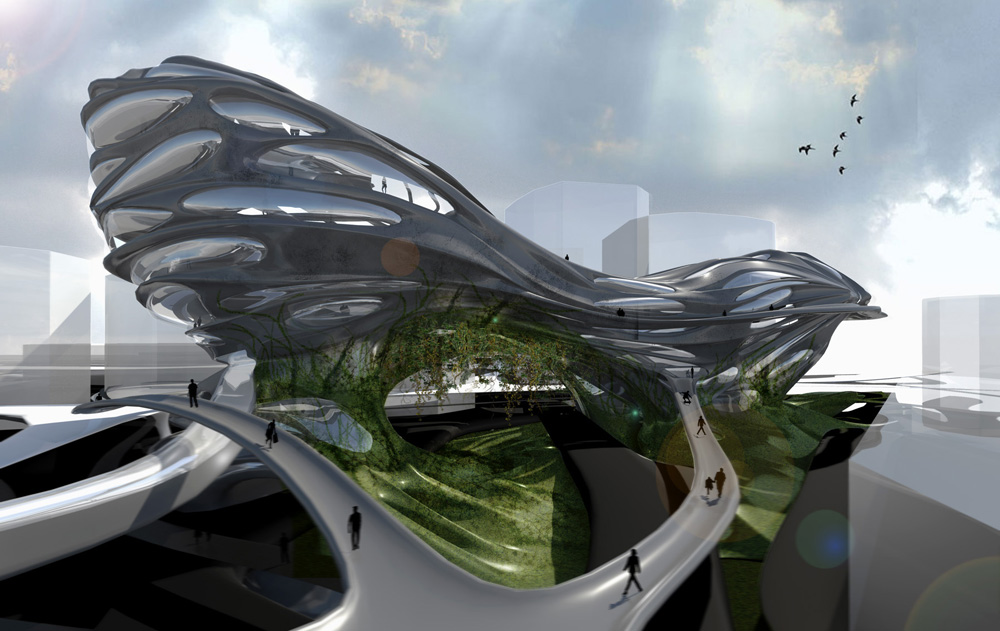
Nature inspired Architecture

The following projects are all inspired by the structures in nature. When we visualise of organic forms we think of fluid random shapes, but really they are very strong geometric structures. I love the idea of going back to nature for inspiration for something so essential like a building but it shows how perfect nature can be.

Pop-Up Bowooss Bionic Research Pavilion- Students at The School of Architecture at Saarland University

The Water Cube Olympic Stadium
United Nations Memorial Design- ACME

Structures in Nature

I think researching structures in nature will benefit my this project. It fascinates me how mathematical nature is. Beehives are made up of perfect hexagons and the veins in a leaf evenly spaced so that nutrients reach every part of it. I found this book in the library which is full of these structures and I think improve my construction skills.

Initial Research

Here are some examples of where textiles and architecture meet. 
Elizabeth Delf creates structural forms that can be worn on the body or displayed as installation. This got me thinking about the relationship between structural form and the body.
Kvadrat Clouds is a three-dimentional textile tile concept designed by Ronan and Ervan Bouroullec. As a product for your home, no two are the same as the client aranges the piece however they want. I am interested in geometric forms and how they fit together. This is something I would like to explore when experimenting with materials. Interiors is a possible context for me to explore as an outcome.
Ernesto Netto is an contemporary installation artist who creates pieces inspired by organic forms. This is something I would like to explore as I am interested in structures in nature and how they have inspired design. 

Elizabeth Delfs

Kvadrat Clouds

Ernesto Netto

Locating Brief

For this project we are required to write our own brief as it is a self-directed project. I am keen to continue researching some of the themes and ideas from the Intentions brief such as pattern, repetition, rhythm and symmetry. I am also going to bare architecture in mind as a potential context, but will not restrict myself to this alone. We have been given several live briefs to choose from, either to work on separately or in conjunction with our personal project. I have chosen the Urban Outfitters brief (Jewellery) because I feel this will push me to work outside of my comfort zone as the final outcome is a product. I would like to learn how to work in this design driven way having an end product/design in mind. I will research Urban Outfitters to get an idea of their target audience as well as their current products. Initially I will combine the two projects but if at any point feel the direction of the two is different then I will work on them separately. 

Sunday, 24 November 2013

Intentions Unit Evaluation

I have thoroughly enjoyed this project. I have learnt so much about myself and my way of working. I am really pleased with my outcomes and feel I have really pushed myself to try new things. Looking back on my work I think the project has been driven by my stitch research. I have questioned stitch and what it means and feel this way of thinking has pushed me to risk take and experiment. I have pushed new materials to really understand their capabilities and had fun at the same time. I have gained confidence in my drawing by breaking down barriers such as wanting it to look perfect. I now have a more free and expressive approach which is so much more enjoyable. Drawing regularly in the last few weeks of the project really has helped me in understanding my work and developing my ideas. I think using found materials is something I want to continue with. It allowed me to be more experimental and expressive in my approach as I was not precious with them because they were free. I think routine and structure is very important in my way of working. I found that the days I came in around 9am and left at 5pm were far more productive than the days I came in at lunch and then forced myself to stay late out of guilt. Pacing myself is also important. I think maybe I wore myself out after the first three weeks which could have contributed to my lack of creativity in the middle of the project. When you have a really long day it is counterproductive, as the next day you are so tired that you don't work very well. So sticking to working hours I think help me to stay motivated. I have also come up with things to do in future projects when I have an off week, so to keep my mind working when I am not feeling so creative. I still can't quite believe that my context has ended up as architecture but feel excited to explore this further as I really enjoyed creating my visualisations. I have really developed my practice and am looking forward to applying the things I have learnt in the next project.

Architectural Visualisations

I used drawing to apply my samples to an architectural context. My photoshop skills are not great but I am pleased with the outcome of these visualisations. I would never have expected to be doing this kind of thing. It's nothing like I've ever done before. I photographed the water at Salford Quays and buildings around the University campus. The 1st and 3rd drawings I designed especially for the context. I have learnt new skills on photoshop during the process and now feel way more confident to use it more.


Bridge and Tunnel Research

I can see some of my samples in a bridge/tunnel context which I never would have expected. And....these are another form of connection, stitching two locations together.

Arndale Footbridge, Manchester

Tunnel-Bridge Linking Mabel Tylecote with Geoffrey Manton Buildings 


MMU Link Gallery

La Barra Bridge, Uruguay

A Rhythmic Process

This last week I have mainly been drawing my samples. With the idea of architecture as a possible context I have been thinking about how I can apply them. I really enjoyed drawing the wire mesh used in some of my samples. Because drawing it accurately pretty much impossible, it really freed me up to be experimental. The process of drawing lines back and forth back and forth is rhythmic in itself bringing it back to my concept.


Philip Beesley


Philip Beesley: Hylozoic Ground from VernissageTV on Vimeo.

"Philip Beesley is a Canada-based architect who has spent years blurring the lines between nature and technology. In 2008, he began work on the Hyozolic series — a collection of immersive installations that react to, and evolve with, the movements of people who pass through them. The idea, according to Beesley, is to create a "metabolic architecture," whereby manmade structures are seen not as inanimate, fixed objects, but as living, breathing entities, capable of regeneration and growth."

http://www.theverge.com/2013/8/16/4624738/radiant-soil-philip-beesley-architecture-installation-edf-fondation-paris


Morphology in Architecture


Tutorial 18th November

It had been two weeks since we last saw Fiona so it felt like I had loads to show. She commented on the structural, architectural qualities of my samples which isn't something I had thought of before. We also talked about context and until now I had just seen them as sculptural forms that show my journey. But after 2 mins of discussion we came up with fashion, product design and architectural outcomes. This is something to think about over the last week before deadline.

Fiona mentioned Morphology which is the study of organic forms. There have been architecture installation exhibitions where designers showcase ideas and concepts using nature as inspiration. Some artists create "living" structures that react to the environment using future technologies.
HygroScope - Meteorosensitive Morphology - independently active architectural form inside custom made GLASBAU HAHN case at Centre Pompidou
http://www.glasbau-hahn.com/en/display-cases/display-case-news/display-case-news-detail/?tx_ttnews%5Btt_news%5D=36&cHash=689067e18fa59d38c8055ea992d4d936

Which is the Stitch?

The sample below started out by stitching into a surface. I have then constructed them into forms. But without the surfaces the stitched materials would not be able to hold their shape, so is the surface the stitch as it connects the piece together??


Finding Form

Once I found some materials that actually excited me I had another go at 'Finding Form' which was a workshop Fiona ran a few weeks ago. At the time I couldn't get into it but I think it was because I had uninspiring materials. Now I had the orange plastic fencing I was after I really wanted to push it as a material and see what it could do. I used mainly cable ties to fasten it together and sometimes wire. I like how the cable ties add the the rhythm of the samples though. The process of twisting, bending and fastening was quite rhythmic and repetitive too. I tried to consider the forms with and without a surface to develop a better understanding of the structural qualities the fencing has to offer.


Friday, 22 November 2013

Connecting Through Music

I have been to a few gigs recently and they really got me thinking about connecting through sound. This works on several levels. 
There is the physical connection of two or more people experiencing sound or music simultaneously, whether that be live at a gig or on record. The sound energy is sensed by the body and perceived in the mind, which then causes us to release energy, maybe dancing, singing or just general enjoyment, creating an atmosphere in the room which in turn is also experienced by everyone. So the energy in the room is connecting everyone in it.
Then there is the nostalgic connection between two or more people who have heard a record and each have specific memories and emotions attached to it. If they were to meet they would have that song in common, therefore a connection between them would exist. 

Heart Drawings


Here are a selection of drawings I did whilst listening to Ed's heart beat, trying to capture the rhythm. I really enjoyed the process and found it very relaxing. I was hoping that Ed would be able to feel his heart beating (he sometimes can, but only either when he's stressed, or the rhythm fluctuates, neither of which I want for him) and he could then communicate that to me somehow. But it wasn't noticeable enough so I rested my head on Ed's chest instead so I could hear myself. I experimented with different marks and tried not to put to much thought into it, just letting the rhythm feed through. I think this will have a positive effect on the way I work from now on as it really loosened me up.

Could the connection between Ed's heart and my drawings be seen as a stitch??


Cornelia Parker- Cold Dark Matter: An Exploded View

 I like the way this piece hangs in the space along side her use of order and pattern in a somewhat chaotic environment. Yet overall the piece feels calm and tranquil. The objects look like they have been frozen in time and space after the start of an explosion. I also like the use of light in the centre of the piece, creating shadows on the surrounding walls adding extra depth, almost like an echo. 
Cold Dark Matter, Cornelia Parker 1991

http://www.timeout.com/london/art/cornelia-parker-deconstructed

Thursday, 21 November 2013

Tutorial 11th November with Jane McKeating

Today we had our tutorial with Jane McKeating, director of studies, as Fiona was poorly. I was dubious at first as I wasn't too keen on having to explain my whole project, and was really looking forward to talk to Fiona. But it turned out to be a great tutorial! It was so good to hear a different perspective, and it was really useful explaining my project from the start as it helped me to see the links in my work and to see how far I've come. Jane questioned whether my samples had to relate to a surface, or could I try without. Or can the surface add to the form?

Monday, 11 November 2013

A Morning of Sampling

I spent the morning working with my new materials so that I would have some samples to take to my tutorial in the afternoon. I mainly just responded to the materials but also tried to let my drawings feed into some of the samples too. I will probably spend all of this week working on sampling. I want to push the scale of my work whilst continuing to explore rhythm, pattern and connecting.
Polystyrene stitched through rubber flooring 

Rolled up wire mesh linked with blue cotton yarn

Orange plastic fencing rolled up and attached to rubber flooring using cable ties